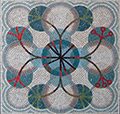

I’ve tried to make a living as a mosaicist in a variety of ways. Sometimes I have put on exhibitions, or been invited to be in ones other people have organised. For a while, a substantial part of my earnings came from teaching mosaic. I’ve worked to commission, and I’ve raised the money for projects I wanted to do from grant awarding bodies like the Arts Council. All of them have some appeal — it’s great to know where the next bit of money is coming from, and that’s what’s good about working to commission. It can be enjoyable too, to be forced to think in a way that you wouldn’t naturally — I’m quite sure I wouldn’t have made an enormous floor in the shape of a nautilus shell if I hadn’t been invited to do it. But doing it taught me a lot — in fact it really made me understand the mosaic principle of ‘two into one’, which I expect a lot of you will already know, but which I’ll write about tomorrow, for anyone who doesn’t really understand why you would want or need to do it. Really, it’s about making the mosaic line (or andamento, as mosaic people call it) look really fluid and not jerky. A mosaic that has been made with that in mind is generally much more flowing and elegant looking than one that hasn’t.
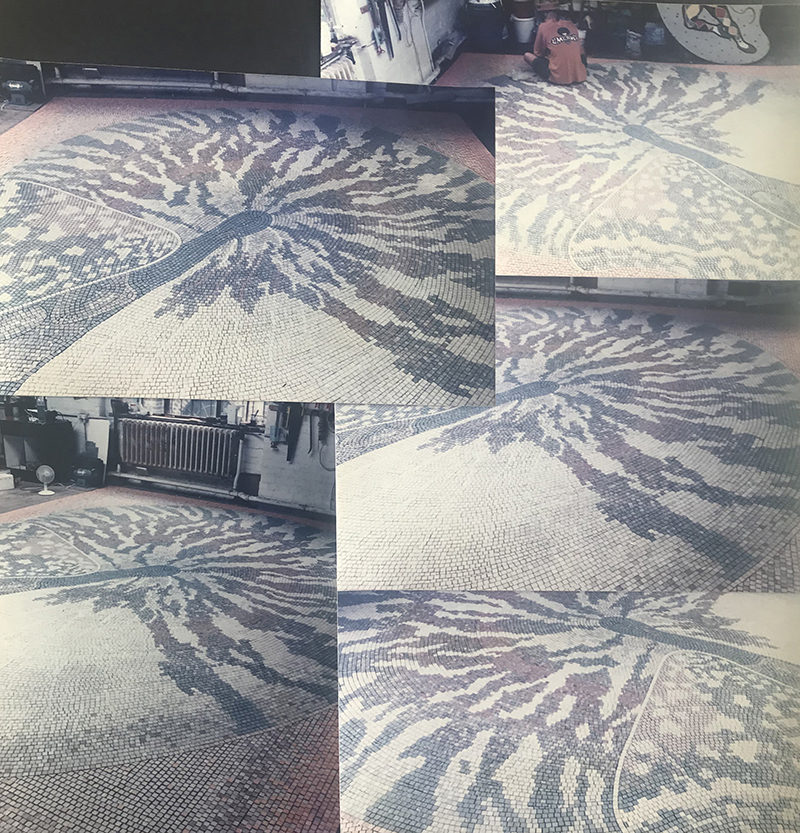
Here are some pictures of the mosaic floor I made for a hotel in the Maldives — years ago now. The lightest of the terracotta coloured tesserae (which were all hand made in and exported to us from Singapore) were rather soft, as terracotta tiles tend to be. The material we used alongside it (as instructed by the client) was marble. This would have been much harder wearing. It’s rather anomalous to combine such hard and soft materials, and I sometimes wonder if it has survived.
Just to return to the terracotta tiles. Several of the tiles had footprints on them. They had obviously been walked over by an animal while they were drying. I like to imagine the animal was something exotic, but I suppose it was more likely to have been the owner’s dog. The tiles were 20mm thick — much thicker than the marble tiles we cut down from standard 10mm format. We cut them into a similar width, and then halved the depth with a wet saw. It was a fussy, messy business. Anyone who did it got covered in wet slurry. They had to wear ear defenders. It was cold and horribly noisy. No one liked the job and no one ever lasted very long as the operator of the wet saw. Everyone had better things to do with their lives. In fact, a lot of very talented artists and musicians were kind enough to try it out for a while.

 A Mosaicist's Life and Work