
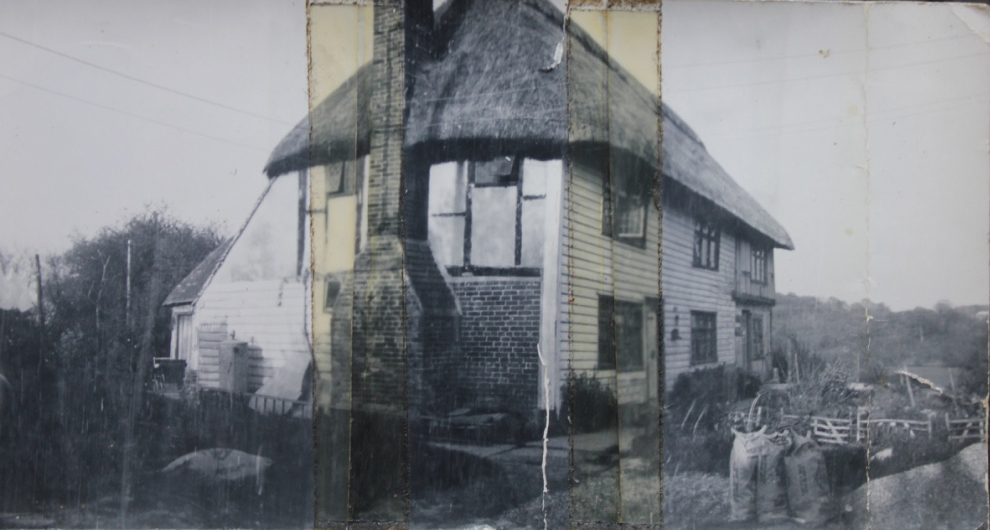
When I set up on my own it was a struggle to find information as to how to do mosaic, or where to buy the tools and materials. I became interested when I saw a TV programme about the UK’s Italian community. I learned that not only had mosaic been a thriving trade amongst Italian economic migrants (who started coming as early as the 19th century to make mosaics for the floors of big civic institutions like town halls, and government buildings) but there were still Italians who did it to this day — this day being the 1980s. It struck me as completely inspiring. I wanted to do something creative and artisanal that connected me to the past. I may have got that idea from my father, who had been a farmer in one of the most beautiful places in the country. The farm was mostly woodland and the land was either hilly or infertile and our family found it impossible to make a living. Despite my father’s enormous efforts, the farm, which had been handed down to him by his own migrant father (who’d bought it in a characteristic burst of excitement and impractical optimism, seduced by its beauty) defeated him. We had to sell up. The farm went to someone who didn’t need to make a living from it. He was a millionaire, had a double barrelled name, and was a cousin of the Queen. Those things seemed very striking to me as a child, in the days before there were so many millionaires. In other circumstances, perhaps I would have been a farmer since I found everything about it fascinating. Like mosaic, it required resourcefulness, creativity and it would have connected me with the past (in all sorts of curious ways — our farmhouse had a well in the kitchen, for example) but I knew, immediately, when I heard about mosaic and the Italian community, that I’d found my thing, and I’ve been doing it for more than thirty years.
Last year was extremely busy. I went from job to job without much time for clearing up, so for the past couple of weeks I have been sorting through piles that have been there for months; in some cases, for many, many months. As I do it, I’ve been coming across detritus from years ago, and I thought I would document some of the things I found as they represent not just my own history, but some mosaic history, along with broader changes in society.
When I started, mosaic tiles weren’t as light as they are now. They were much thicker. I often come across old tiles in mixed boxes (mixed boxes are the sign of a mosaicist too busy to put things away). They are hard to use if you are working in reverse — you have to build up the back to keep the face of the mosaic even looking and mosaic tilers who know how to do it are not easy to find. In order to install mosaic properly, you really need to have done a great deal of it, and ideally, to have learned in the difficult days of working with sand, cement and (sometimes, but not always) lime. Despite what the adhesive manufacturers may tell you, modern methods are not always the most reliable or effective ones. Because of the difficulties they cause the fixer, those old thicker mosaic tiles are mostly used by people working by the direct, rather than the indirect method. I still use them, but only because of the skills of Walter Bernardin, my Italian mosaic installer and friend.
The material isn’t as thick or as hard wearing as it was, but I suppose, looking at it from another perspective, it uses fewer raw materials to produce. In a world of finite resources, that may not be so bad a thing. And of course, thinner materials lead to a diminished cost of production for the manufacturers, and a lower cost in freight. Mind you, when I started, there were still British mosaic manufacturers so the journey from factory to workshop wasn’t such a long one, but those manufacturers didn’t last into the 1990s.
Another difference in the mosaic in those days was the space between the joints. Mosaic tiles were laid much, much tighter than they are today. It’s easy to demonstrate this by showing you two tile jigs, one from the 1970s and one from the 1990s. I will put up some photos of them later in the week. Mosaic jigs were tools left over really from the 60s and early 70s when there had been a vogue (as there was again the late 90s and 00s) for sheeted-up modernist-looking mosaic. In fact some of my earliest mosaic purchasing memories involve jigs — going to Edgar Udny, which was under the railway arches in Bondway in Vauxhall, where two West Indian guys would sit and make random mixes using the jigs. Once again, I suppose the reason for the change was a matter of profitability. If you made the joints wider and kept the price the same, you made more money from less material. As the joints widened, a vogue began for wider jointed mosaic generally. It was easier and quicker to make, and no one except the old timers seemed to mind the difference.
*I’ll continue this in a few days, but meanwhile, for those who don’t know, a mixed box is a box of random tiles, assembled at the end of a job, and most mosaic studios contain many of them. A jig is a metal, wooden, fibre glass or plastic tray in which whole tiles are loose laid in a geometric grid, before being papered up. I will explain more about them soon.

 A Mosaicist's Life and Work